Our Process
From the moment a pallet enters our yard to the moment it reaches your dock — every step is intentional, efficient, and sustainable.
Our 13-step process was developed by founder Garrett Caldwell and refined over years of hands-on experience. It reflects our core belief that quality and sustainability are not opposing forces — they are complementary. By controlling every stage of the pallet lifecycle, we deliver consistent products while diverting 98 percent of materials from landfill.
See Our Process in Action
Request a quote or schedule a yard tour.
50,000+
Pallets processed per month at our facility
98%
Waste diversion rate — almost nothing goes to landfill
13
Distinct steps in our quality-controlled process
24 hrs
Turnaround from order to delivery in Bakersfield
The Complete Lifecycle
At Bakersfield Pallet Co., we manage the complete pallet lifecycle from intake to delivery and beyond. Our process is designed to extract maximum value from every piece of wood that enters our facility while maintaining strict quality standards for every pallet that leaves it.
The process below details all 13 steps. Each step includes built-in quality checkpoints and documentation that support full traceability. This means we can tell you exactly where a pallet came from, what was done to it, and when it was processed — information that is increasingly important for supply chain transparency and compliance purposes.
Operations Manager Oakley Thorne oversees day-to-day process execution, while Sustainability Director Wren Castellano tracks and reports on the environmental impact of each stage. Together, they ensure that our process delivers both quality products and measurable environmental benefits.
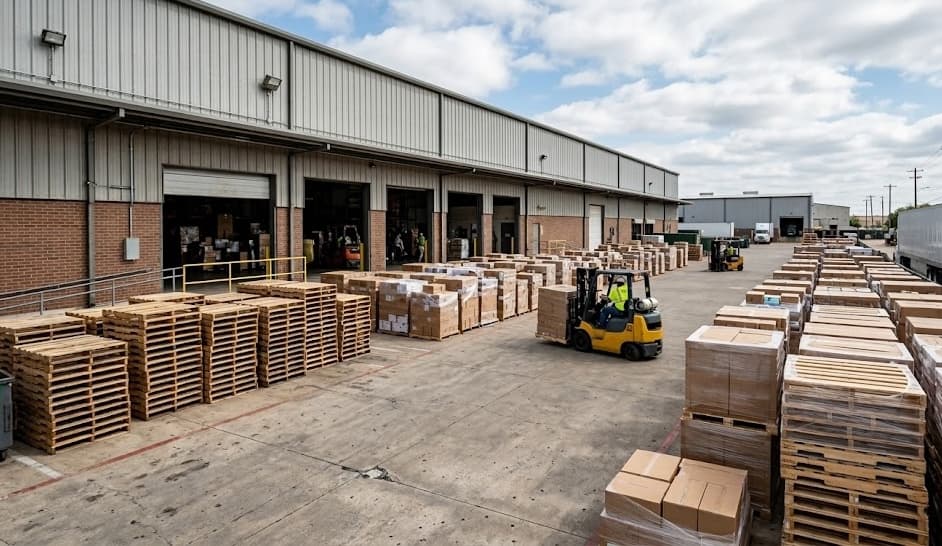
Every pallet passes through a carefully designed workflow -- from intake to delivery
Initial Contact & Consultation
Every relationship begins with a conversation. When you reach out to Bakersfield Pallet Co. via our contact form or email, our team takes the time to understand your specific pallet needs. We ask about your product types, shipping requirements, volume expectations, and any industry-specific compliance needs. This initial consultation helps us recommend the right pallet grade, size, and material for your application — saving you money and preventing costly mismatches.
Collection & Intake
Pallets arrive at our 3240 Patton Way facility via customer drop-off, our pickup service, or partner referrals. Every incoming load is documented with quantity, source, and initial condition assessment. Our intake team logs each load into our tracking system, creating a chain of custody from the moment pallets enter our yard. This traceability is essential for quality control and for providing accurate sustainability data to our partner customers.
Sorting & Initial Assessment
Once unloaded, every pallet is individually evaluated by our sorting team. Pallets are separated into four primary categories: reusable as-is (Grade A or B without repair), repairable (pallets that can be restored to Grade B or C after targeted repairs), dismantlable (damaged beyond economical repair but containing salvageable boards), and recyclable (wood that will be chipped into mulch, bedding, or biomass). This initial sort determines the most efficient and sustainable path for each pallet.
Grading & Classification
Pallets categorized as reusable enter our formal grading process, led by Operations Manager Oakley Thorne. Each pallet undergoes a multi-point inspection covering structural integrity, dimensional accuracy, cosmetic condition, and fastener security. Based on this inspection, pallets are assigned a grade (A, B, or C) and tagged for inventory. Our grading team completes regular calibration exercises to ensure consistency across all inspectors, so you can order by grade with confidence.
Repair & Refurbishment
Pallets flagged for repair enter our workshop where skilled technicians restore them to their target grade. Common repairs include replacing broken or missing deckboards, reinforcing cracked stringers with companion boards, removing protruding nails and staples, and resetting shifted boards. Our repair team uses pneumatic fastening systems for speed and consistency, and all replacement lumber is sourced from our repair stock inventory — boards salvaged from dismantled pallets — keeping the process sustainable.
Dismantling & Parts Recovery
Pallets that are too damaged to repair economically are dismantled by our team. Good deckboards and stringer sections are extracted and added to our repair stock inventory. This parts recovery process is a critical part of our sustainability model — every usable board we salvage reduces demand for new lumber. Metal fasteners are separated and sent to a metal recycling partner. Our dismantling team processes hundreds of pallets per day using specialized pry bar and saw tools.
Cleaning & Debris Removal
Before entering inventory or the heat treatment process, pallets are cleaned of any debris, loose material, labels, banding remnants, and foreign objects. Cleaning improves the appearance of the pallet, ensures accurate grading, and eliminates potential contamination risks for food-adjacent and pharmaceutical applications. Pallets destined for Grade A inventory receive an enhanced cleaning process that includes hand inspection of all surfaces.
Heat Treatment & Compliance
Pallets destined for export or food-grade applications enter our ISPM-15 certified heat treatment kiln. The kiln raises the core temperature of the wood to a minimum of 56 degrees Celsius (132.8 degrees Fahrenheit) and maintains that temperature for at least 30 minutes. This treatment eliminates insects, larvae, and pathogens without the use of any chemicals. Core temperature is monitored in real-time using digital probes, and temperature logs are archived for full compliance documentation.
Quality Inspection & Final Check
After all processing is complete — whether the pallet was graded as-is, repaired, cleaned, or heat-treated — it undergoes a final quality check before entering our sales inventory. This inspection verifies that the pallet meets the standard for its assigned grade. Inspectors check for protruding fasteners, proper dimensional tolerances, structural soundness, and correct ISPM-15 stamping if applicable. Any pallet that fails the final check is returned for additional work or downgraded.
Inventory Management & Storage
Processed pallets are organized in our outdoor inventory yard by size, grade, and material type. Pallets are stacked on level ground in clearly marked zones for efficient retrieval. Our inventory management system tracks every pallet from intake to sale, providing real-time availability data that allows us to give customers accurate stock information. Premium Grade A and Like-New pallets are stored under covered shelters to protect them from weather exposure.
Order Fulfillment & Staging
When your order comes in, our fulfillment team pulls pallets from inventory according to the exact grade, size, and quantity specified. Pallets are staged in the loading area and undergo a final spot-check before being loaded onto a delivery vehicle or prepared for customer pickup. For standing orders, this process is automated — your regular delivery is pulled and staged on a predetermined schedule without requiring individual order submissions.
Delivery & Transportation
Our in-house delivery fleet serves the Bakersfield metropolitan area with same-day capability and the broader Central Valley on scheduled routes. Deliveries are made using flatbed trucks equipped with forklifts for offloading at your location. Our drivers are trained to stack and place pallets where you need them — not just drop them at the curb. For customers outside our delivery range, we coordinate with freight carriers for full truckload shipments.
Follow-Up & Ongoing Support
After delivery, our team follows up to ensure your order met expectations. We welcome feedback on pallet quality, delivery experience, and overall service. For recurring customers, we schedule periodic reviews to assess whether your pallet needs have changed, whether a different grade might better suit your operations, or whether your volume warrants upgraded pricing. Our goal is a long-term partnership, not a one-time transaction.
Sustainability at Every Step
Our process is designed to minimize waste at every stage. Here is how sustainability is built into each phase of our operation.
Reuse First
The most sustainable thing we can do with a pallet is keep it in service. Our grading process identifies every pallet that can be reused as-is, avoiding unnecessary processing and preserving the embedded energy in the wood.
Repair Over Replace
When a pallet needs work, we repair it rather than replacing it entirely. This extends the life of the original lumber by years and reduces demand for new wood. Our repair stock inventory of salvaged boards keeps this cycle going.
Parts Recovery
Pallets beyond economical repair are dismantled for parts. Good boards are salvaged and reused. This keeps usable lumber in circulation and reduces waste to only the truly unusable material.
Wood Recycling
Wood that cannot be reused or repaired is processed through our industrial chipper. The resulting chips become mulch, animal bedding, biomass fuel, or compost — giving the material a second purpose rather than a landfill destination.
Metal Recycling
Nails, staples, and metal plates recovered during dismantling are separated magnetically and sent to a metal recycling partner. Even the fasteners get a second life.
Zero-Waste Goal
Our 98 percent waste diversion rate means that only 2 percent of material entering our yard ends up in a landfill — and that fraction consists solely of contaminated wood that cannot be safely processed. We are continuously working to get that number even closer to zero.
Transparency Is Our Standard
We welcome customers to visit our facility and see our process firsthand. There is nothing behind closed doors — every step described above happens in plain view at 3240 Patton Way, Bakersfield. Reach out to schedule a tour of our operation and meet the team.